

ChatGPT vs. Claude for PR: Which AI Should You Trust With Your Brand?

Another Tuesday night, another blinking cursor on a blank screen. You know you need to write that media pitch, update your company blog, or draft a LinkedIn post to stay relevant. But after a full day of running your business, the creative energy just isn’t there. You’ve heard about AI, maybe even dabbled with ChatGPT, but you’re not sure if it’s a genuine solution or just another tech fad. Can you really trust a robot with your brand’s voice? And with so many tools out there, which one is actually right for the specific, nuanced work of public relations?
This isn’t another hype-filled article promising that AI will “revolutionise” your business. This is a practical, practitioner’s guide to using AI writing assistants for public relations, written for Australian small business owners. As someone with over 20 years in the communications trenches, I’ve spent hundreds of hours testing these tools for real-world PR tasks. I’ll break down the real differences between the major players—ChatGPT, Claude, and Perplexity—and show you exactly how to use them to get tangible results, not just generic, soulless content. We’ll cover what they do well, what they fail at spectacularly, and exactly what they cost. By the end of this post, you’ll have a clear framework for choosing the right tool and a step-by-step workflow for your first AI-assisted PR task.
The New Creative Team: ChatGPT, Claude & Perplexity
Think of these AI assistants not as replacements for your strategic thinking, but as incredibly fast, surprisingly capable junior team members. Each has a distinct personality and skillset. Your job as the director is to know who to assign to which task.
ChatGPT (The Eager Intern): Powered by OpenAI, ChatGPT is the most well-known of the bunch. It’s creative, versatile, and enthusiastic, great for brainstorming, drafting initial concepts, and generating a high volume of ideas. Like a keen intern, it sometimes needs specific, firm direction to avoid going off on a tangent, and its work always requires a thorough fact-check.
Claude (The Thoughtful Analyst): Developed by Anthropic with a focus on safety and ethics, Claude is the more cautious, analytical member of the team. It excels at summarising large documents, handling nuanced topics with greater care, and producing more structured, coherent long-form content. It’s less prone to the wild creativity or “hallucinations” of ChatGPT, making it a more reliable choice for tasks requiring accuracy and a formal tone.
Perplexity (The Specialist Researcher): Perplexity isn’t a direct competitor in the same way; it’s a research-focused tool that acts as your team’s specialist. Its key strength is its ability to search the web in real-time and provide answers with direct citations. For any PR task that requires up-to-date information, fact-checking, or competitor analysis, Perplexity is the go-to resource to brief your other AI writers.
How do you choose the right AI writing partner for PR?
Choosing the right AI assistant depends entirely on the specific PR task at hand. There is no single “best” tool for everything. The key is to match the tool’s strengths to your immediate goal. Are you brainstorming angles for a new campaign? Drafting a formal press release? Or researching journalists to pitch? Each of these requires a different approach and, often, a different AI.
A good starting point is to assess your task against three criteria: creativity, accuracy, and context. For highly creative tasks like generating social media hooks or campaign slogans, ChatGPT’s flair for the dramatic is an asset. For tasks demanding high accuracy, such as drafting a technical backgrounder or a formal company statement, Claude’s more conservative and analytical nature is preferable. For anything requiring real-time information or external data, such as finding recent articles by a specific journalist, Perplexity is the only reliable choice.
The Contenders: A Head-to-Head Breakdown
ChatGPT Plus: The Creative Brainstormer
Best for: Creative idea generation, social media content, and drafting initial concepts.
For approximately $30 AUD per month ($20 USD), ChatGPT Plus serves as the versatile, creative engine in your PR toolkit. Its core strength lies in its ability to brainstorm a wide array of angles, generate catchy social media hooks, and produce first drafts with speed and enthusiasm. Think of it as the eager intern, ready to tackle any creative challenge you throw at it. However, this versatility comes with a key limitation: its output can sometimes be generic and requires rigorous fact-checking, especially for data-sensitive PR content. While it has a good grasp of Australian context, it can occasionally default to US-centric phrasing if not specifically prompted.
Claude Pro: The Nuanced Content Writer
Best for: Media pitches, press releases, blog posts, and summarising reports.
At a similar price point of around $30 AUD per month ($20 USD), Claude Pro from Anthropic offers a more analytical and structured approach to content generation. Its primary strength is producing nuanced, coherent long-form content, making it the ideal choice for drafting professional media pitches, formal press releases, and in-depth blog posts. Claude’s more cautious nature means it is less prone to the creative “hallucinations” of other models, resulting in more reliable and accurate outputs for tasks that demand a formal tone. It demonstrates a strong grasp of nuanced language and is generally less biased towards US-centric phrasing, making it a solid choice for the Australian market.
Perplexity Pro: The Specialist Researcher
Best for: Journalist research, fact-checking, trend analysis, and competitor monitoring.
Priced at approximately $25 AUD per month ($16.67 USD on an annual plan), Perplexity Pro is not a direct creative writer but a powerful, specialised research tool. Its core function is to search the web in real-time and deliver answers with direct citations, making it an indispensable asset for evidence-based PR work. Use it to research journalists, fact-check claims, analyse industry trends, or monitor competitor activity. Its key limitation is that it is not designed for creative writing or long-form content generation. For any PR task requiring up-to-date information and verifiable sources, especially within the Australian context, Perplexity Pro is the essential first step to inform your content strategy.
Real-World Workflow: Crafting a Media Pitch (With Prompts)
Let’s put this into practice. Here is a step-by-step workflow for creating a targeted media pitch, a task that typically takes a PR professional 2-3 hours. With this AI-assisted process, you can get it done in about 45 minutes.
Objective: Pitch a story about your small business, a sustainable accounting firm, to a specific journalist who covers green technology.
Time Estimate: 45 minutes
Cost: Your AI subscription fee (approx. $30/month)
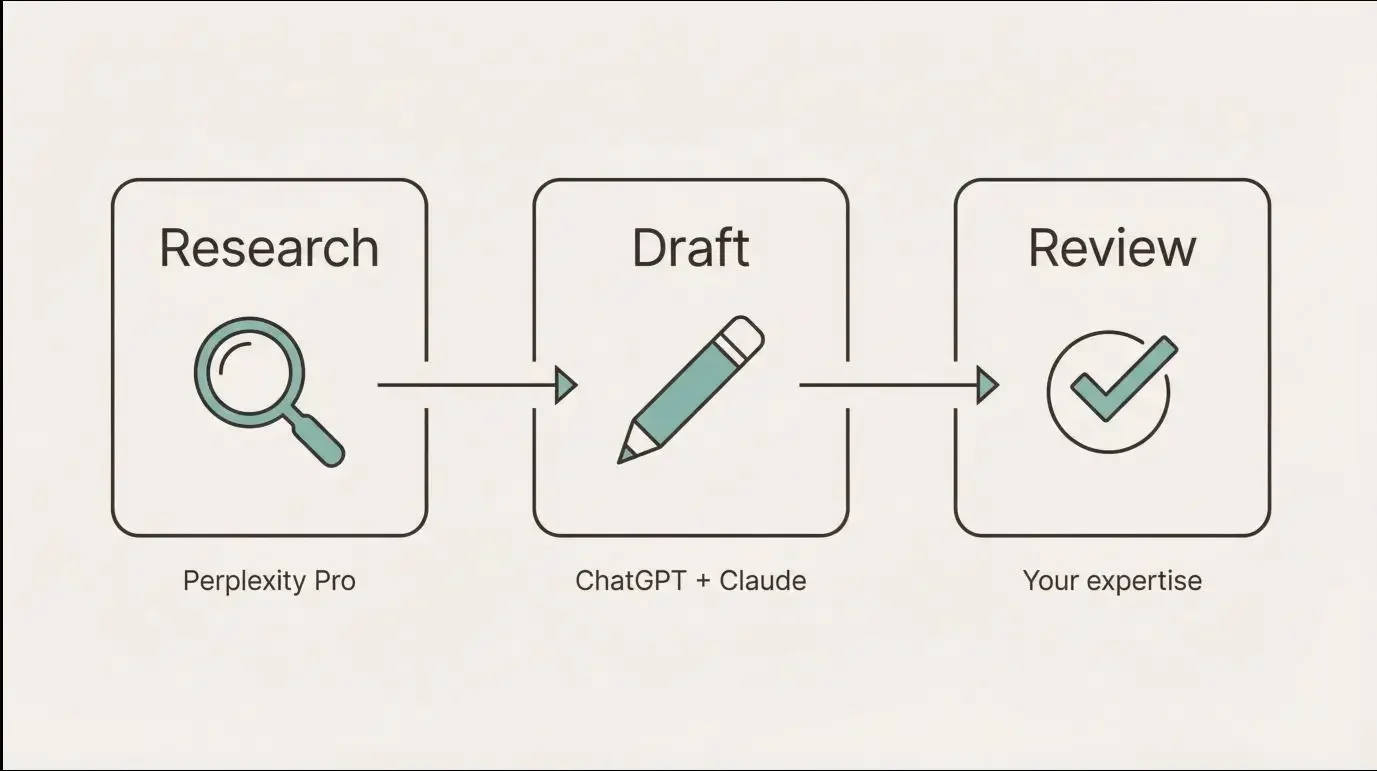
Step 1: Research the Journalist with Perplexity (10 minutes)
Your first step is to understand what the journalist writes about and what their audience cares about. A generic pitch is a dead pitch.
Perplexity Prompt:
> "Analyse the last 5-10 articles written by [Journalist Name] at [Publication]. What are the core themes they focus on? What is the general tone and style of their articles? Identify 3-5 specific topics or angles they have recently covered related to sustainable business or green technology. Provide links to the articles you analyse."
Step 2: Brainstorm Angles with ChatGPT (10 minutes)
Now that you have your research, use ChatGPT to brainstorm a range of potential story angles that align with the journalist’s beat.
ChatGPT Prompt:
> "I am the founder of an Australian sustainable accounting firm called ‘Green Ledger’. We help small businesses track and reduce their carbon footprint through financial reporting. Based on the following research about [Journalist Name]’s work, generate 5 unique and compelling story angles to pitch to them. For each angle, provide a catchy, subject-line-worthy headline. The angles should be newsworthy and relevant to an audience interested in green technology and sustainable business. Here is the research: [Paste Perplexity output here]"
Step 3: Draft the Pitch with Claude (15 minutes)
With your chosen angle, it’s time to draft the pitch. Claude is the best choice here because of its ability to produce a well-structured, professional, and persuasive email.
Claude Prompt:
> "Write a professional and concise media pitch to [Journalist Name] from me, [Your Name], the founder of Green Ledger. Use Australian English spelling and a conversational but professional tone. The pitch must be under 200 words. Use the following angle and headline: [Paste your chosen angle and headline from ChatGPT].
> The pitch must include these key points:
> 1. Acknowledge their specific area of interest (e.g., ‘I’ve been following your coverage of green tech...’).
> 2. Clearly and concisely explain what Green Ledger does.
> 3. Present the story angle as a valuable insight for their readers.
> 4. Offer a clear call to action (e.g., a brief chat).
> Do not use any AI hype words like ‘game-changer’ or ‘revolutionise’. Focus on the practical impact for small businesses."
Step 4: Human Review and Personalisation (10 minutes)
This is the most critical step. Read the draft from Claude. Edit it to ensure it sounds like you. Add a genuine, personal touch. Maybe you reference a specific point in one of their recent articles. This human element is what turns a good pitch into a great one.
What AI Can’t Do (And When to Call a Human)
For all their power, these tools are just that: tools. They have significant limitations, and knowing them is crucial for maintaining your brand’s integrity.
AI can’t build relationships. PR is fundamentally about human connection. An AI can’t have a coffee with a journalist, understand their pressures, or build the long-term trust that leads to consistent media coverage. It can help you be more efficient, but it can’t replace the human element of networking.
AI can’t create a strategy. An AI can execute a task you give it, but it can’t tell you why you should be doing it. It can’t understand your broader business goals, analyse your market position, and develop a multi-channel communications strategy. That requires experience and commercial acumen.
AI can’t handle a crisis. In a crisis, you need nuanced judgment, empathy, and strategic foresight. An AI is not equipped to manage the complexities of reputational risk. When the stakes are high, you need an experienced human advisor.
The Hidden Costs and Traps to Avoid
While the subscription costs are low, the potential costs of misuse are high. Here’s what not to do.
Don’t “copy and paste.” Never take the output from an AI and publish it directly. It will often be generic, may contain factual errors, and will lack your unique voice. Always treat it as a first draft that needs your expertise and polish.
Don’t trust it with sensitive information. These are public models. Never input confidential company data, financial information, or personal details into a public AI tool. Assume anything you type could be seen by others.
Don’t forget your brand voice. It’s easy to let the AI’s default tone take over. You must be vigilant in editing the output to ensure it aligns with your brand’s personality. Create a simple brand voice guide and include it in your prompts to steer the AI in the right direction.
Key Takeaways
There is no single “best” AI for PR.** Choose your tool based on the task: ChatGPT for creativity, Claude for professional writing, and Perplexity for research.
AI is a junior team member, not a director.** Use it to execute tasks and accelerate your workflow, but you must provide the strategy, oversight, and final human touch.
A structured workflow is essential.** A process like the one outlined above—Research, Brainstorm, Draft, Review—ensures you use the right tool at the right time and produce high-quality, accurate work.
The human element is your biggest advantage.** AI can’t build relationships, create strategy, or show genuine empathy. These remain the core, irreplaceable skills of a great communicator.
By using these tools thoughtfully and deliberately, you can move from staring at a blank page to executing a professional, effective PR function for your small business. You can punch above your weight, tell your story consistently, and build the authority your brand deserves.