

How to Turn One Customer Case Study Into Three Months of PR Content (Using AI)
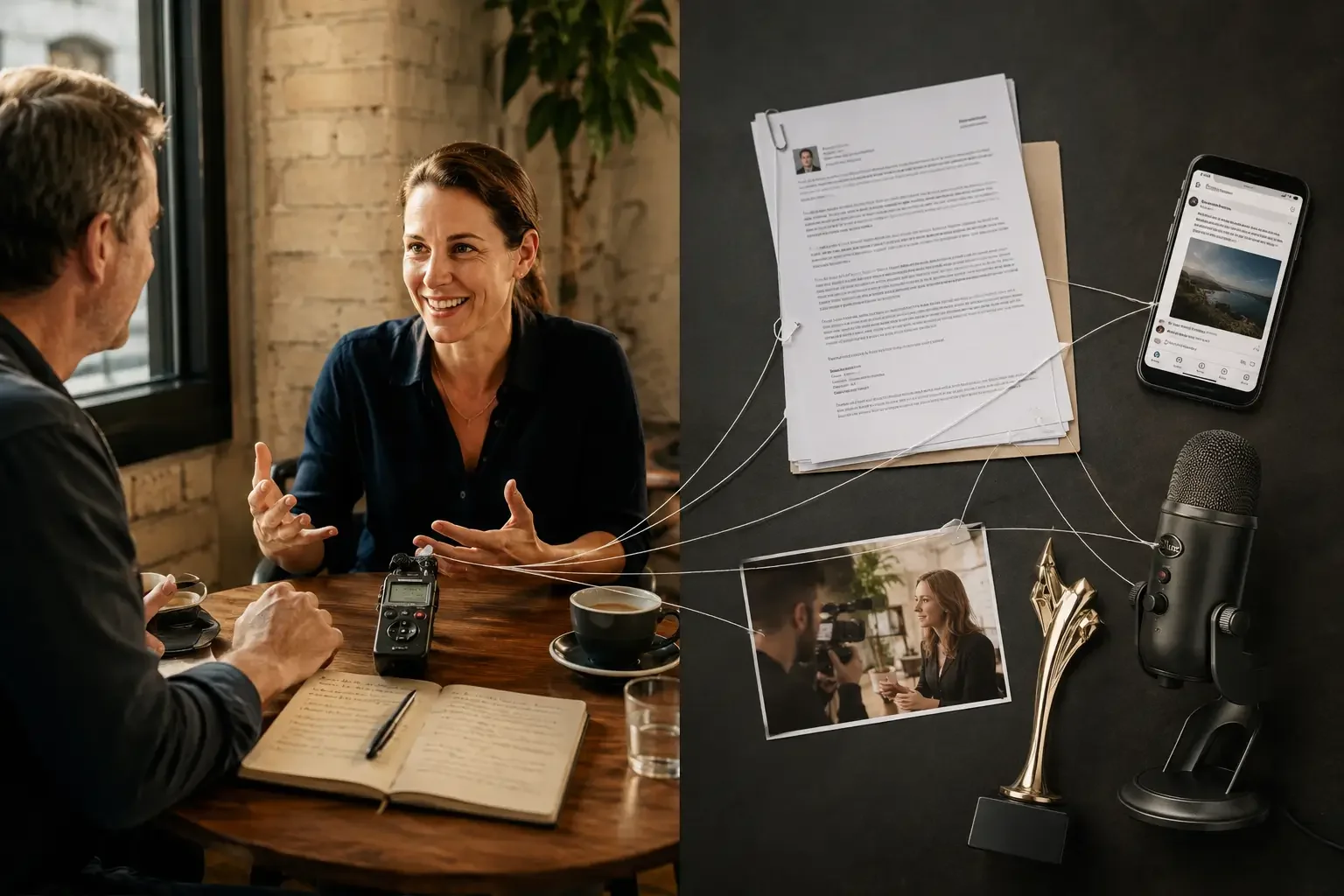
You've done great work for a client. They're happy. Maybe they sent you a glowing email or left you a five-star review. And then you moved on. That story — which represents your best evidence of what you can actually do — quietly sits in your inbox, doing absolutely nothing for your business.
Most small business owners treat case studies as a one-and-done website asset. Write it up, pop it on the site, wait for it to do something. It rarely does. The problem isn't the story. It's the system — or the complete absence of one.
A single strong customer success story, handled correctly, can fuel your PR and content marketing for a full quarter: media pitches, LinkedIn posts, award entries, podcast pitch notes, newsletter content, and more. Here's exactly how to extract that value using AI tools, with rough time estimates and honest guidance on where the process breaks down.
Why Most Case Studies Die on Arrival
The typical case study workflow goes like this: ask a happy client for a quote, write something up, publish it, and wonder why nobody reads it.
Two things are usually wrong. First, the story isn't framed from the audience's perspective — it's framed from the client's. "We delivered great results for Company X" is not interesting to anyone except Company X. What's interesting is the problem Company X had, why it was difficult, and what happened when they solved it. That's a story.
Second, the asset is published in a format that requires effort to find. A PDF or a webpage buried in your navigation isn't content — it's a document. Content is stuff that finds people. Media pitches find journalists. LinkedIn posts find professional networks. Podcast appearances find audiences. One story, distributed correctly, does far more than a page on your website.
What Makes a Case Study PR-Worthy
Before you invest time in any of this, the story needs to pass a basic test. Not every client success is a media story or a compelling LinkedIn post.
Ask yourself: is there a genuine before-and-after? Was there a specific obstacle, a decision moment, or a measurable change? Can you talk about it without a non-disclosure agreement making the detail meaningless? And does the client exist? Meaning, are they a real business your audience can verify, or are you writing vaguely about "a Sydney-based retail client" because they won't go on record?
Anonymous case studies have their place, but they don't work for media pitches or award entries. For those purposes, you need a real business, a willing client, and enough specificity to be credible.
If your story passes that test, you're ready.
Step 1: The Raw Material Interview (30 minutes)
The biggest mistake in case study work is writing from memory or from your own notes. You need the client's voice — their actual words, in their own language, about the problem from their perspective.
Book a 20-to-30 minute call. Don't call it a "case study interview." Call it a catch-up or a check-in. People are more candid when they're not performing.
Record it with their permission. Otter.ai (free for up to 300 minutes per month) or the built-in recording tool on Zoom or Google Meet will produce a usable transcript. If you want better accuracy for an Australian accent, Rev.com charges around $1.50 USD per minute for a human-corrected transcript — worth it for a 20-minute interview.
The questions that get the best material:
"What was the situation before we started working together? What was the actual problem you were trying to solve?"
"What made you decide to do something about it when you did?"
"What were you worried might happen if things stayed the same?"
"What's different now? What can you do that you couldn't do before?"
"If someone asked you to describe what we did for them, what would you say?"
That last question is gold. Whatever they say becomes your testimonial. Don't paraphrase it — use their exact words.
Step 2: Build Your Master Story Document (45 minutes)
Once you have a transcript, open Claude or ChatGPT and paste it in. Then use this prompt:
"The following is a transcript of a client interview. Please extract: (1) the core problem they were experiencing before working with us, using their exact language as much as possible; (2) the key decision moment — what made them act; (3) the solution or change that happened; (4) the specific outcomes or results; (5) any quotes that could stand alone as testimonials. Don't add interpretation or marketing language. Just extract what's there."
This produces a structured brief you'll use as source material for everything else. Don't skip this step or try to write the final assets directly from the transcript — the extraction step saves you from re-reading the transcript every time you need to repurpose the story.
The master document should also include: the client's industry, their approximate size, the geographical context (especially if it's Australian), and any numbers or data points from your own records that the client mentioned or confirmed — revenue impact, time saved, cost reduction, whatever is relevant and verifiable.
Step 3: The 12-Week Content Map
This is where most people undersell themselves. They write the case study and stop. Here's what one story can actually produce:
Week 1: The anchor case study. A 500-to-800 word written piece structured as a proper narrative (problem, context, solution, outcome). This lives on your website and forms the foundation for everything else.
Week 2: The LinkedIn post. Take the decision moment from your master document — the thing that made the client finally act — and write a first-person observation about it. Not a summary of the case study. A reflection. Something like: "I had a conversation recently with a business owner who'd been running their [process] on spreadsheets for four years. They knew it was a problem. They just didn't realise how much it was costing them until..."
Prompt for this: "Using this case study summary, write a LinkedIn post of around 200 words. Don't summarise the story — write it as a practitioner's observation about what this situation reveals. Start with the problem, not the outcome. Don't use hype language or marketing phrasing. First-person perspective."
Weeks 3 and 4: The media pitch. If the story has a broader angle — a trend it illustrates, a common mistake it corrects, something that's happening across the industry — it can support a journalist pitch. You're not pitching the case study. You're pitching the broader insight, with the case study as your proof point.
Prompt: "Based on this case study, suggest three media pitch angles that would appeal to a journalist. Each angle should address a broader trend or issue, not just describe what happened for this specific client. Keep them to two sentences each."
Weeks 5 and 6: The newsletter section. If you run a newsletter (and you should be), the case study becomes a "client story" section. Two to three paragraphs, told as a narrative, with a one-line takeaway for the reader.
Week 7 and 8: The award entry hook. Many Australian business awards ask for evidence of client impact. Your case study becomes the foundation for one or more entries. The master document already has the structure award entries need: situation, approach, result.
Weeks 9 and 10: The podcast pitch note. Podcast hosts need to know why their audience would care about having you on. Your case study gives you a concrete story to anchor your pitch. The format: "I work with [type of business]. Recently, one of my clients [brief description of situation and result]. I think the broader lesson about [topic] would be valuable to your audience."
Weeks 11 and 12: Repurpose the LinkedIn post. Change the framing, not the substance. The first version was about the client's decision moment. This version could be about a common misconception the story corrects, or a question it raises about the industry.
That's 12 weeks of substantive content from a single 30-minute conversation.
What AI Can't Do Here
AI is good at restructuring, extracting, and reformatting content that already exists. It is not good at replacing the source material.
If you skip the client interview and ask AI to "write a case study," you'll get a plausible-sounding document that contains no real information. It will read like every other case study on the internet — vague, optimistic, and forgettable. AI cannot invent the client's actual language, their specific situation, or the numbers that make a story credible.
AI also can't tell you which angle will resonate with a journalist, because it doesn't know your journalist. That still requires reading the publication, understanding the beat, and making a judgment call about what's timely. AI can give you pitch options. Selecting the right one is still your job.
And AI will smooth everything out. It tends to remove the rough edges — the hesitations, the specific frustrations, the slightly awkward things clients say that are actually the most authentic and credible parts of their story. When reviewing any AI-generated content from your interview material, go back and add those moments in. The imperfections are what make it believable.
What This Actually Costs
The core tools for this workflow:
Otter.ai for transcription: free up to 300 minutes per month, then around $20 AUD per month for the Pro plan. For most small businesses, the free tier is enough.
Claude Pro or ChatGPT Plus: approximately $33 AUD and $28 AUD per month respectively. Either works for this process. Claude tends to be more careful with source material; ChatGPT tends to be more fluent in first-draft generation. Using both costs under $65 AUD per month total.
If you're using a platform like AI-Stories (from $29 AUD per month), many of these workflows are built around structured PR outputs, which means you can move faster from raw transcript to finished pitch or post without building the prompts from scratch each time.
Beyond tools, the main cost is your time: roughly two hours of focused work to produce the master document and the initial assets, then 20 to 30 minutes per week to adapt and schedule content across the quarter.
What NOT to Do
Don't publish a case study as a PDF and call it done. PDFs are where case studies go to be forgotten.
Don't write the case study yourself without talking to the client. Your recollection of the project and their experience of the project are almost always different, and their version is always more compelling.
Don't use the client's name without written permission. A short email confirming they're happy to be named and quoted is sufficient. Keep it.
Don't let AI invent specifics. If the client said revenue increased "significantly," don't let the AI render that as "a 47% revenue increase." Made-up numbers will catch up with you eventually, and they corrode the trust you're trying to build.
Don't try to make every case study into a media story. Most aren't. That's fine. Media coverage is one outcome, not the goal. The goal is a credible, reusable story asset that builds your authority over time.
Key Takeaways
A single client interview can produce 12 weeks of PR and content assets — anchor case study, LinkedIn posts, media pitch angles, newsletter content, award entries, and podcast pitch notes.
The quality of everything downstream depends on the quality of the raw material. Prioritise the client interview over every other step.
AI is useful for restructuring and repurposing content that already exists. It cannot replace the interview, select the right media angle, or restore the authentic rough edges it tends to smooth away.
Anonymous case studies are useful for your website but largely useless for media pitches and award entries. You need a named, verifiable client to get traction in those channels.
The master story document — an extracted brief built from your interview transcript — is the most important asset in this workflow. Build it once, use it for everything.